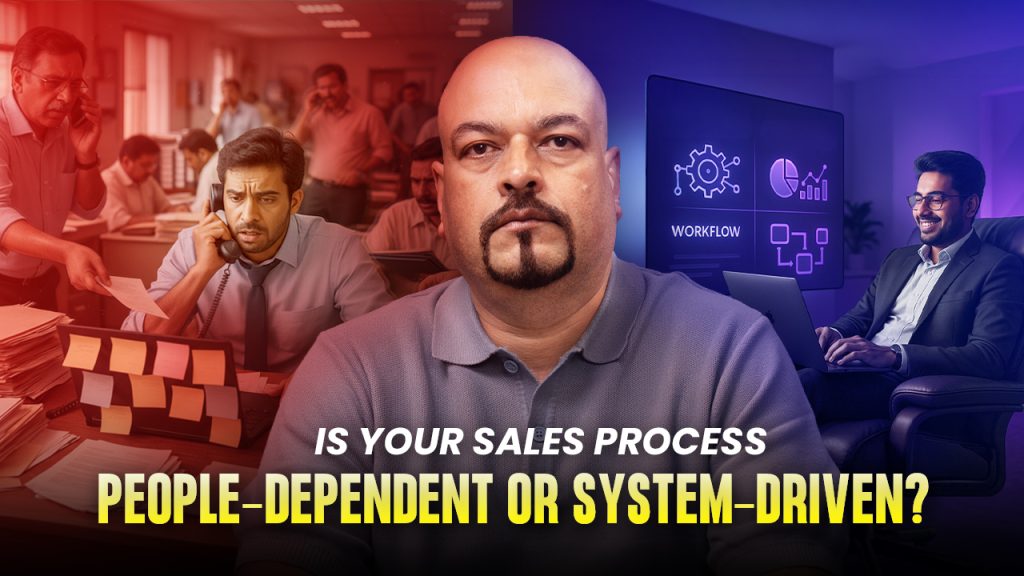


In the EPC world—where projects stretch over months, involve multiple approvals, and require serious techno-commercial clarity—sales is already a tough game. Yet for many MSME EPC founders in India, the real challenge isn’t market competition or tendering complexity. Rather, it’s the silent bottleneck inside the organisation:
Sales is heavily dependent on a few individuals.
Maybe it’s your seasoned sales engineer who knows every client personally.
Perhaps it’s that one BD guy who can charm anyone into a meeting.
Or, in many cases, you—the founder—are still the primary closer.
As a result, performance fluctuates wildly. One great month is followed by two slow ones. Growth feels inconsistent, and scaling becomes painfully slow.
Luckily, shifting to a system-driven sales engine changes everything.
What Exactly Is a People-Dependent Sales Process?
A people-dependent sales process is one where outcomes rely largely on the personal abilities of individuals—memory, communication style, relationships, and technical knowledge.
You might be dealing with such a system if:
- Only specific salespeople can close meaningful projects
- Lead information isn’t documented and stays in people’s minds
- Follow-ups rely on “remembering” instead of structured mechanisms
- New hires take too long to onboard
- Sales forecasting feels more like intuition than data
When everything depends on individuals, the entire organisation becomes vulnerable.
What Does a System-Driven Sales Process Look Like?
Unlike a people-dependent approach, a system-driven process focuses on structure, clarity, and consistency. It creates a standardized approach that guides all sales activities.
Here’s what that looks like in practice:
- Every salesperson follows the same steps, documents the same data, and uses the same tools
- Templates reduce errors and ensure brand consistency
- Follow-ups are driven by reminders and automation—not memory
- Sales data becomes visible and actionable
- New hires ramp up faster because they follow a clear playbook
Although the system drives the process, people still add value. However, they operate within a structure rather than creating their own methods.
Why Do MSME EPCs in India Lean Toward People-Dependent Sales?
Several common patterns contribute to this tendency.
1. Founders Lead Sales in the Early Years
Since founders usually close the first few projects themselves, the entire sales method evolves around their personal style.
2. Processes Are Rarely Documented
Even if some steps exist, they live in scattered Excel sheets, WhatsApp chats, or individual hard drives.
3. Hiring Prioritizes Experience Over Process-Fit
Experienced hires bring their own way of working, which leads to inconsistent methods.
4. CRMs Are Installed but Not Adopted
Many companies have CRMs that look impressive but are barely updated. Without enforcement, a CRM becomes a fancy address book.
5. EPC Sales Cycles Are Long and Complex
Without a system, complexity quickly becomes chaos.
Consequently, sales starts to revolve around whoever can “manage the chaos” best.
Depending on a handful of individuals may feel comfortable day-to-day, but it exposes several long-term risks.
1. Revenue Becomes Unpredictable
Inconsistent output leads to unpredictable quarters.
2. Star Performers Gain Unhealthy Control
If they leave, your pipeline collapses. Even their absence for a single month creates a slowdown.
3. Founders Remain the “Chief Closer”
Instead of building the company, you end up firefighting in sales.
4. Scaling Gets Delayed
You can’t grow beyond the bandwidth of a few people.
5. Customer Experience Varies Wildly
Each salesperson communicates differently, resulting in mixed customer experiences.
To grow sustainably, your business needs predictable behaviour—not heroic efforts.
How to Move from People-Dependent to System-Driven Sales
Let’s explore the step-by-step transition.
Step 1: Map Your Sales Value Chain
Begin by laying out every step from lead generation to project handover. Visibility is the first step toward control. Once the flow is mapped, gaps, delays, and inconsistencies become much clearer.
Step 2: Standardize the Activities Inside Each Step
Consider creating:
- Qualification criteria
- BOQ/data collection formats
- A techno-commercial proposal template
- A standard follow-up cadence
- Negotiation scripts
- A proposal turnaround SOP
By doing this, you ensure that anyone—experienced or not—follows the same sequence.
Step 3: Implement a CRM the Right Way
A CRM should enforce discipline. Therefore, set rules such as:
- Mandatory fields before advancing stages
- Auto-reminders for follow-ups
- Template-driven emails
- Dashboards showing stage-wise movement
- Funnel reports with win/loss reasons
When used properly, a CRM becomes the backbone of your sales system.
Step 4: Train the Team on the System, Not Just Soft Skills
Skills differ from person to person, but systems create consistent behaviour.
This includes training your team to:
- Use the CRM correctly
- Follow documentation SOPs
- Present proposals in a structured format
- Maintain defined follow-up intervals
- Communicate in a standardized manner
Once everyone follows a uniform approach, performance becomes far more predictable.
Step 5: Introduce a Weekly Review Rhythm
Regular reviews keep the system alive.
Your weekly meeting should include:
- Funnel updates
- Leads stuck in a specific stage
- Aged leads
- Proposal turnaround time
- Pipeline gaps
- Conversion ratios
This is where insights turn into improvements.
Step 6: Automate Whatever You Can
Automation dramatically increases consistency. It also reduces errors and speeds up the sales cycle.
Useful automations include:
- Email follow-up sequences
- Task reminders
- Proposal sharing workflows
- Management dashboards
- Lead assignment rules
With automation in place, sales becomes smoother and more reliable.
A Real Example from the Indian EPC Ecosystem
One of the Pune-based EPC companies I worked with relied entirely on two senior sales professionals. Everyone else struggled, and the founder constantly stepped in to close deals.
After implementing a system-driven approach:
- Proposal delays reduced by 30%
- Forecasting accuracy improved dramatically
- New hires became productive within 5 weeks
- Weekly rhythm created smoother communication
- The founder stepped out of daily sales after 6 months
Their team didn’t change.
Their system did.
What This Means for You as an EPC Founder
If you’re building an EPC business that you want to scale—without burning out—then shifting to a process-driven sales engine is non-negotiable. When systems lead and people operate within them, growth becomes predictable. Furthermore, your team feels more confident, customers get a consistent experience, and you finally get the freedom to focus on strategy.
FAQs
1. Is a system-driven process suitable for small EPC companies?
Absolutely. Smaller teams benefit even more because structure reduces chaos.
2. How long does the transition take?
Most companies see stability in 60–90 days.
3. Does it reduce creativity?
Not at all. It provides clarity, not restrictions.
4. Will the team resist?
Initially yes, but once they see less firefighting, they embrace it.
5. Can a CRM truly transform EPC sales?
Yes—when tied to your actual sales process, not used as a standalone tool.